Booking a ticket for a concert of the Geneva International String Academy takes just a few minutes, on a computer or a phone. Here are the steps.
1. Choose the concert
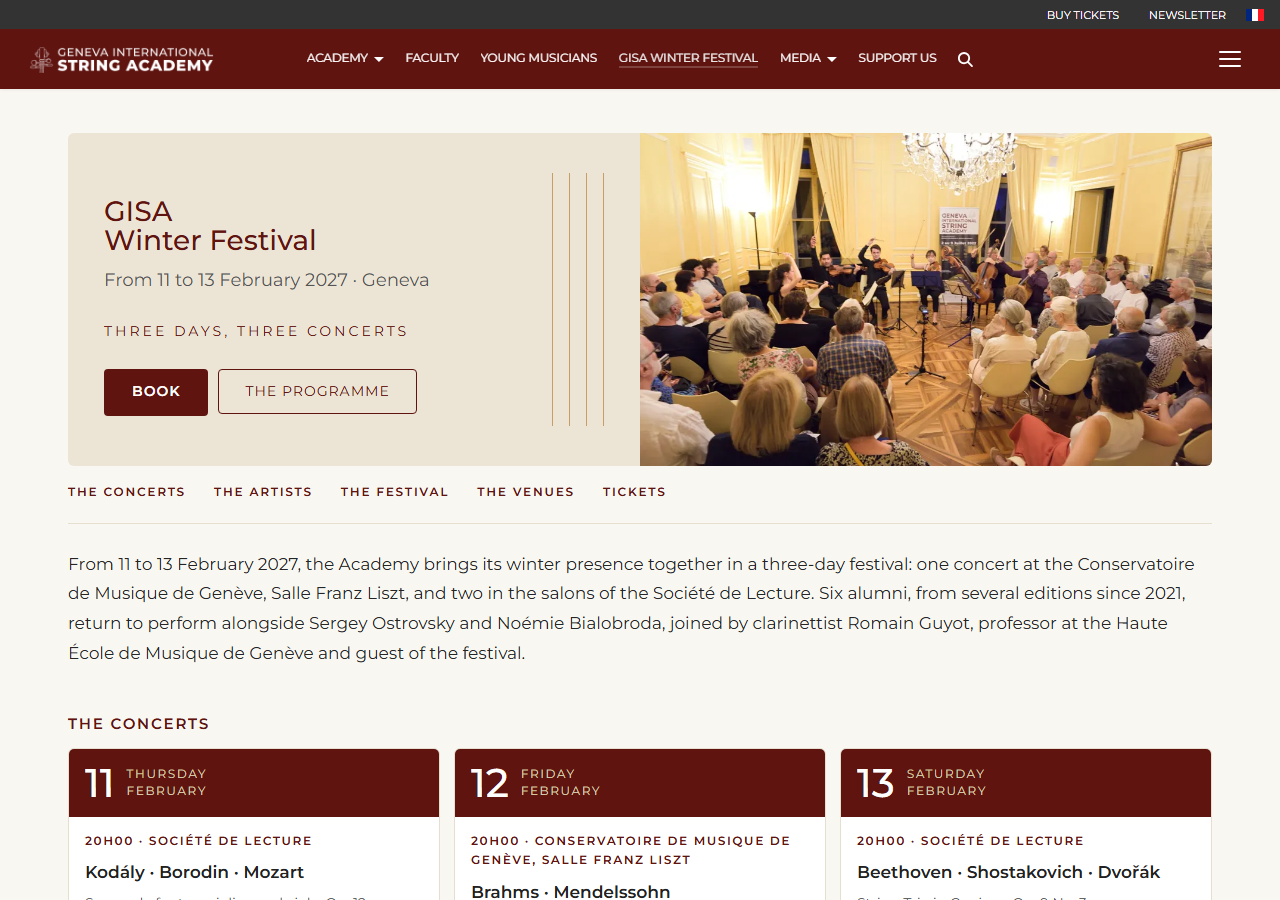
In the menu, open “GISA Winter Festival”. The concerts are listed under “The concerts”: click the one you are interested in.
2. “Book my ticket”
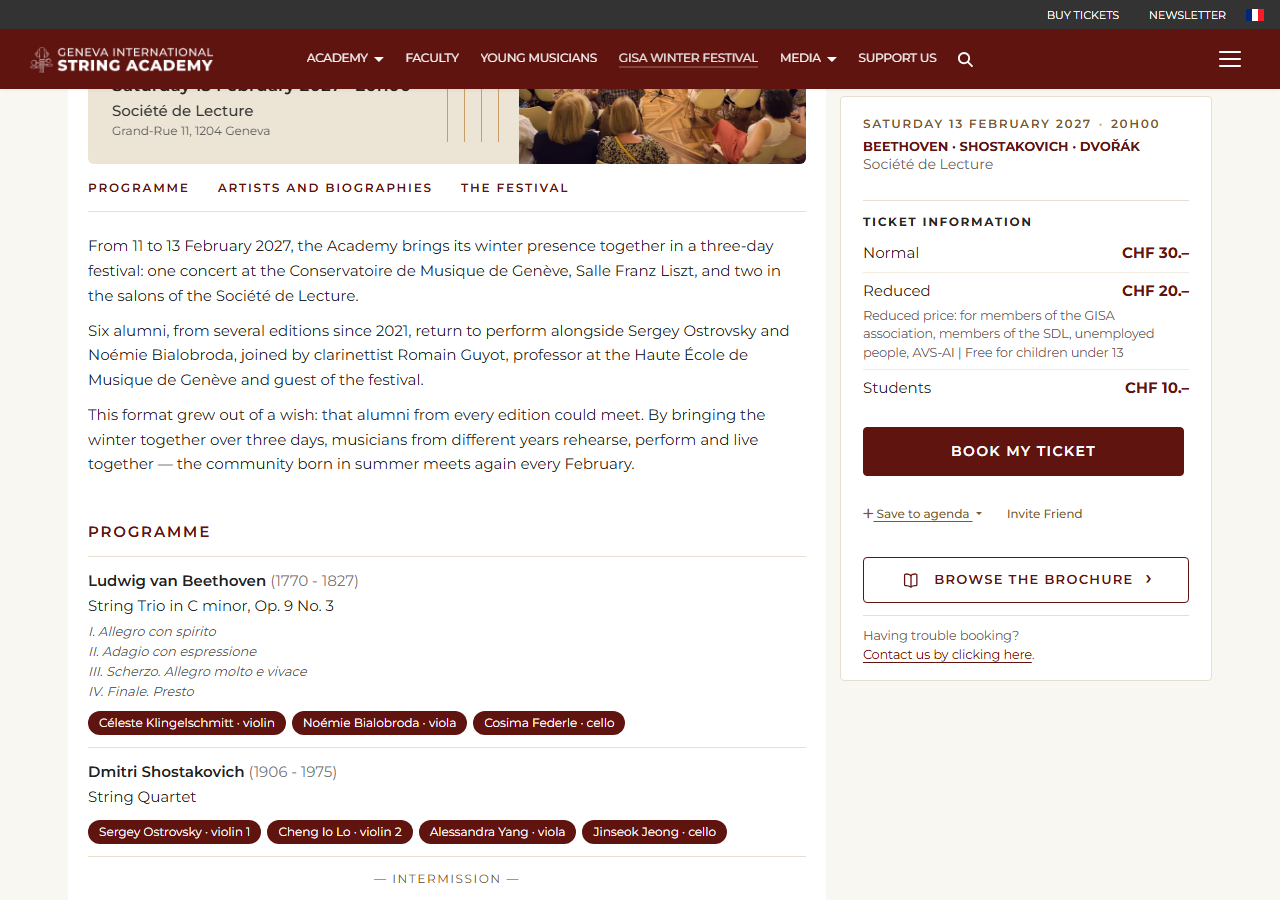
The concert page shows the date, the venue and the prices. Click “Book my ticket”.
3. The number of tickets
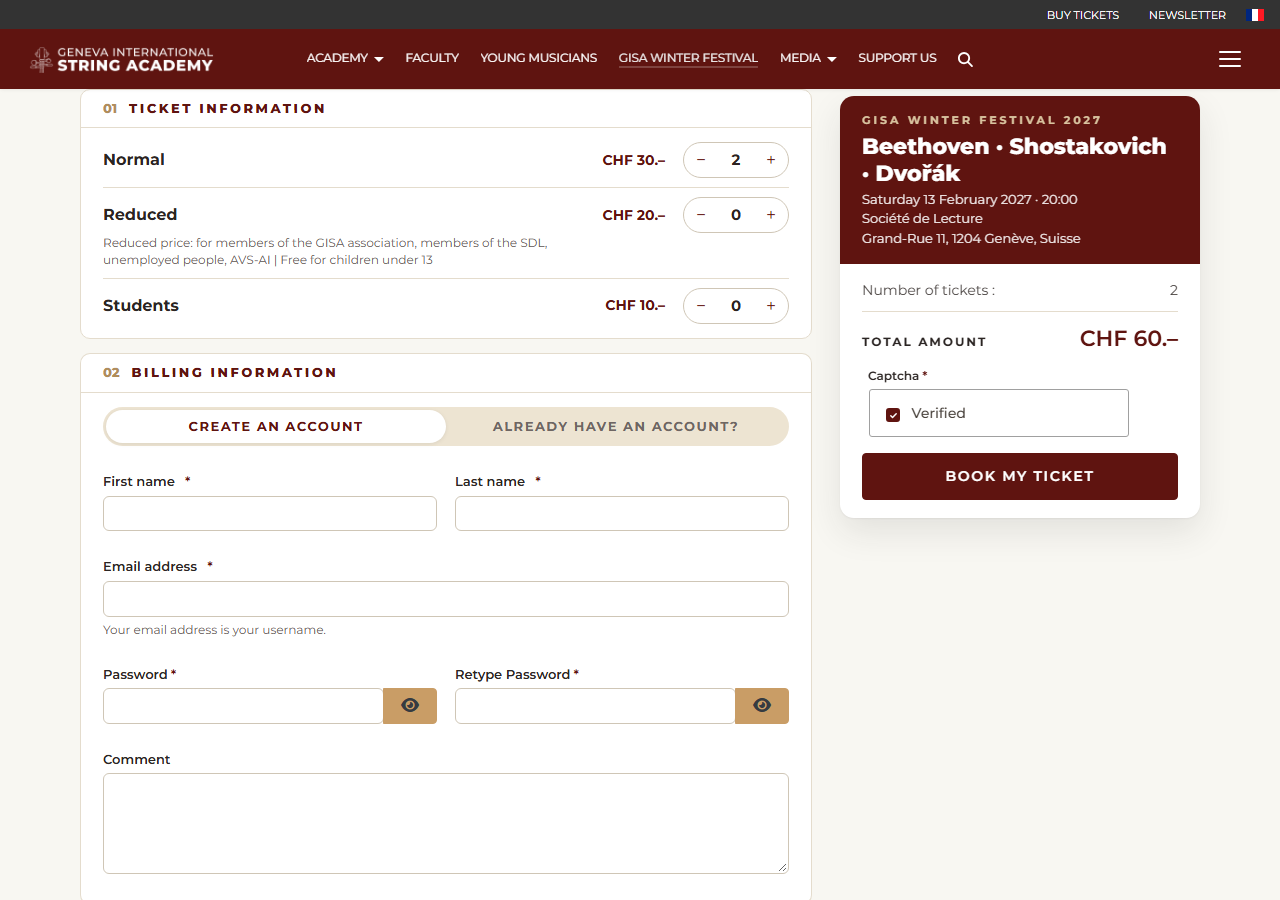
Under “Ticket Information”, add or remove tickets for each price with “+” and “−”. The conditions of the reduced price are shown under that price. The “Total amount” is calculated immediately, on the right of the screen.
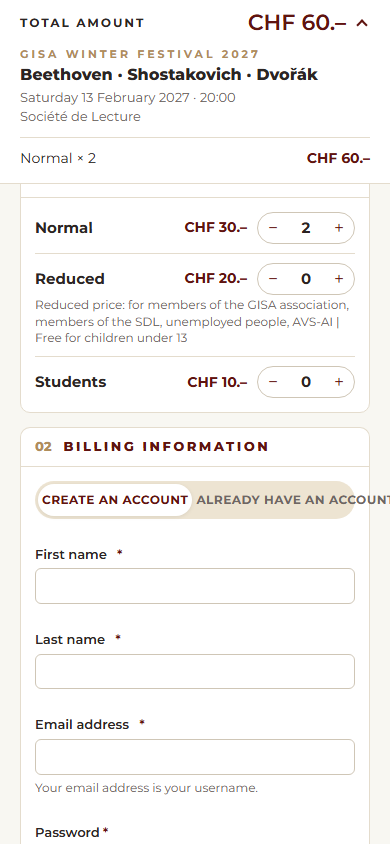
On a phone, the total amount stays at the top of the screen: tap it to see the details of your order.
4. Your details
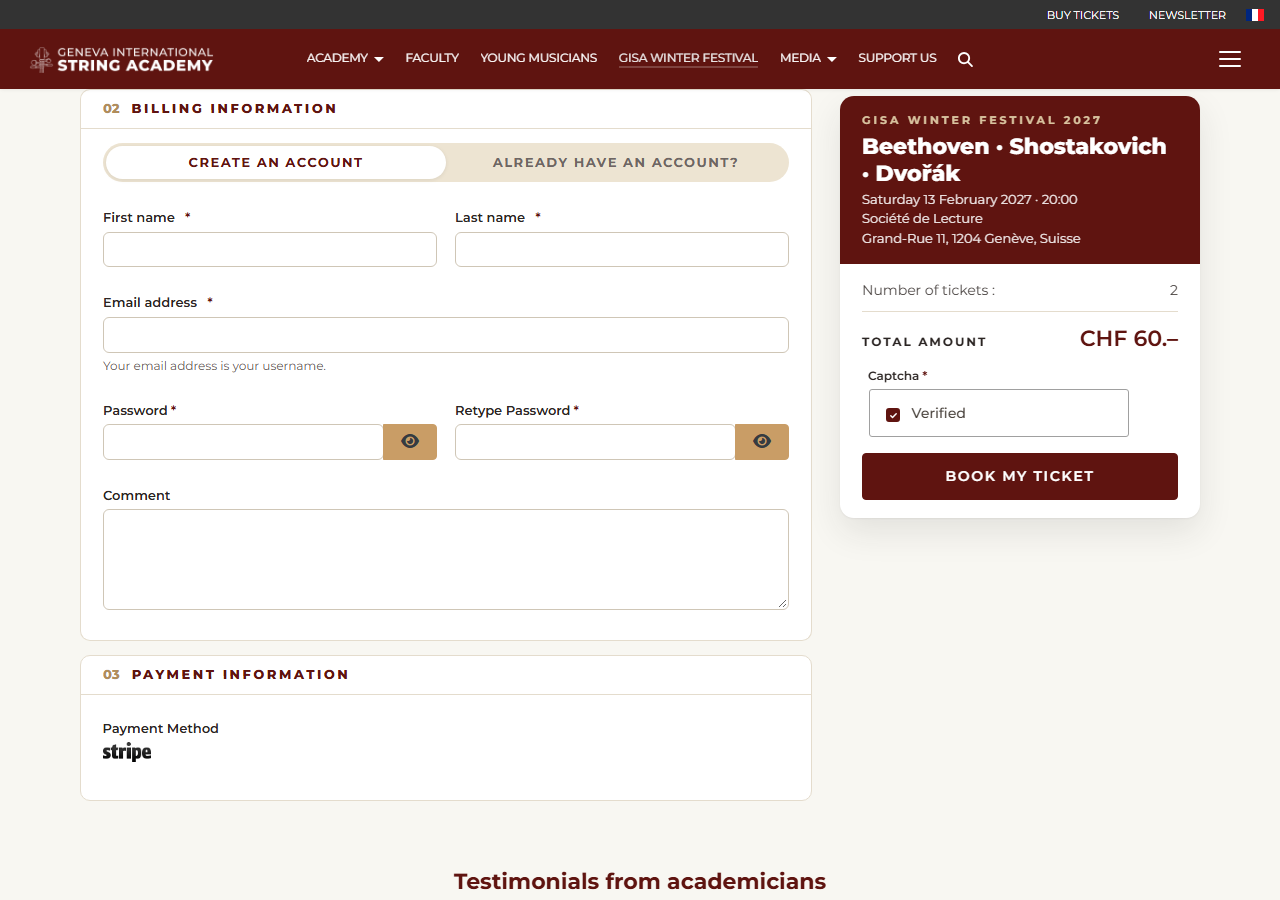
Under “Billing Information”, for a first booking, keep “Create an account” selected and fill in “First name”, “Last name”, “Email address” and “Password”. Your email address is your username; your account lets you find your bookings and your tickets at any time.
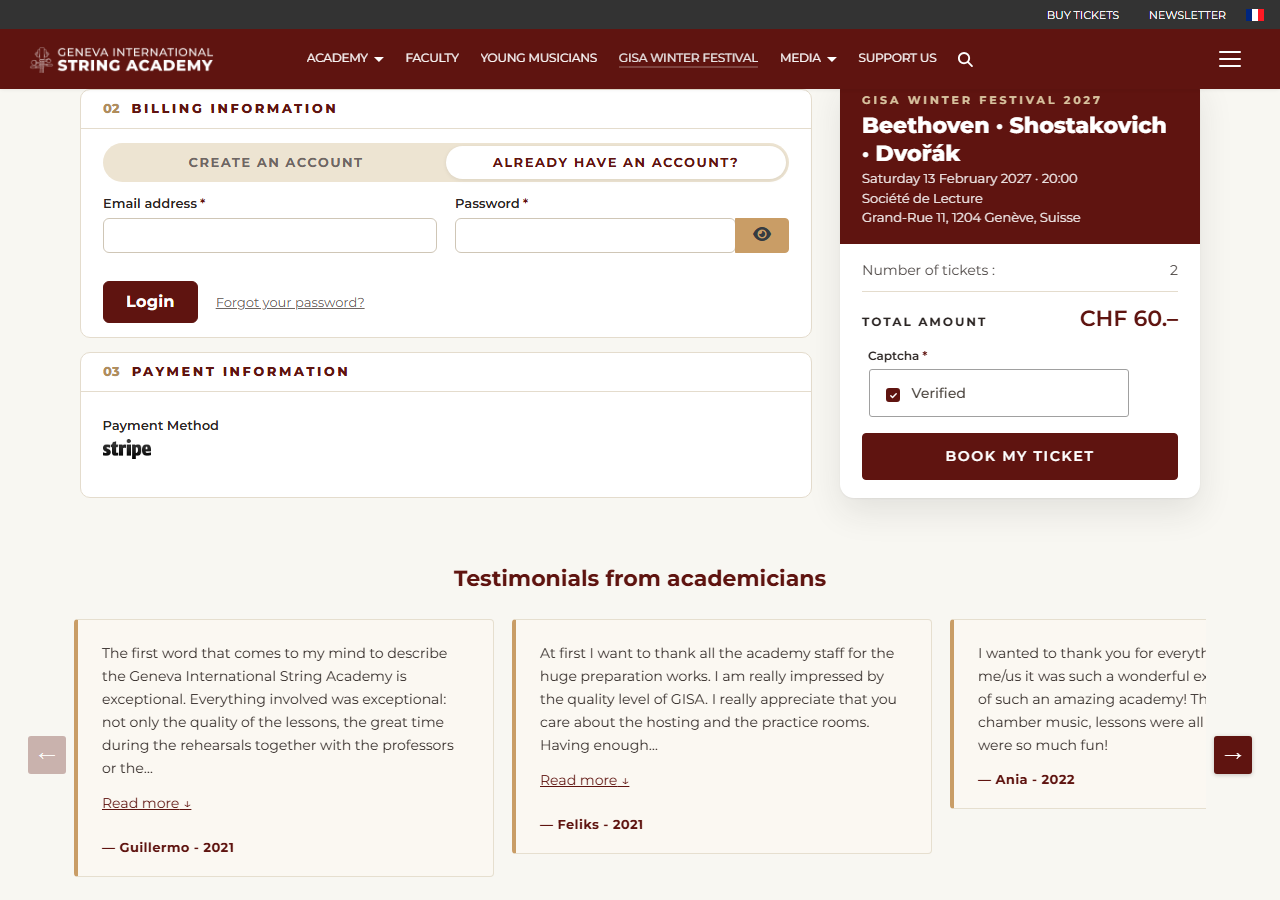
Already have an account? Click “Already have an account?”, enter your email address and password, then “Login”. Forgotten password: “Forgot your password?”.
5. Payment
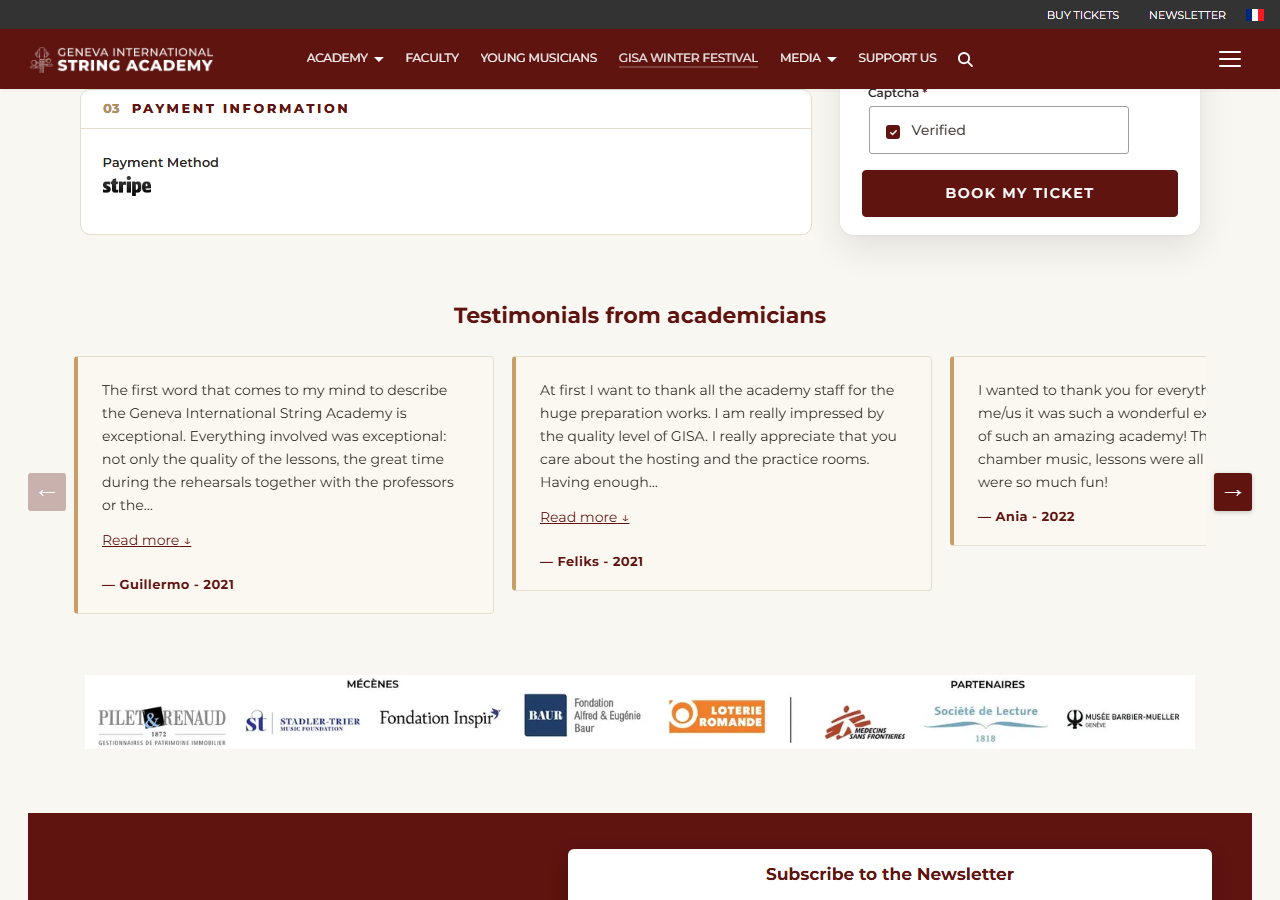
Under “Payment Information”, the payment method is Stripe. Check the number of tickets and the total amount, then click “Book my ticket”: you reach Stripe's secure payment page, where you pay for your order.
6. Your confirmation and your tickets
A confirmation message is displayed, and within a few minutes you receive a confirmation email with your ticket(s). Please present a printed or electronic copy of this email at the box office on the day of the concert.
You can also find your tickets in your account: open “My reservations” in the menu.
Having trouble booking? Contact us by clicking here.
Contact us
A question? Write to us. The Academy team answers applicants and the public.
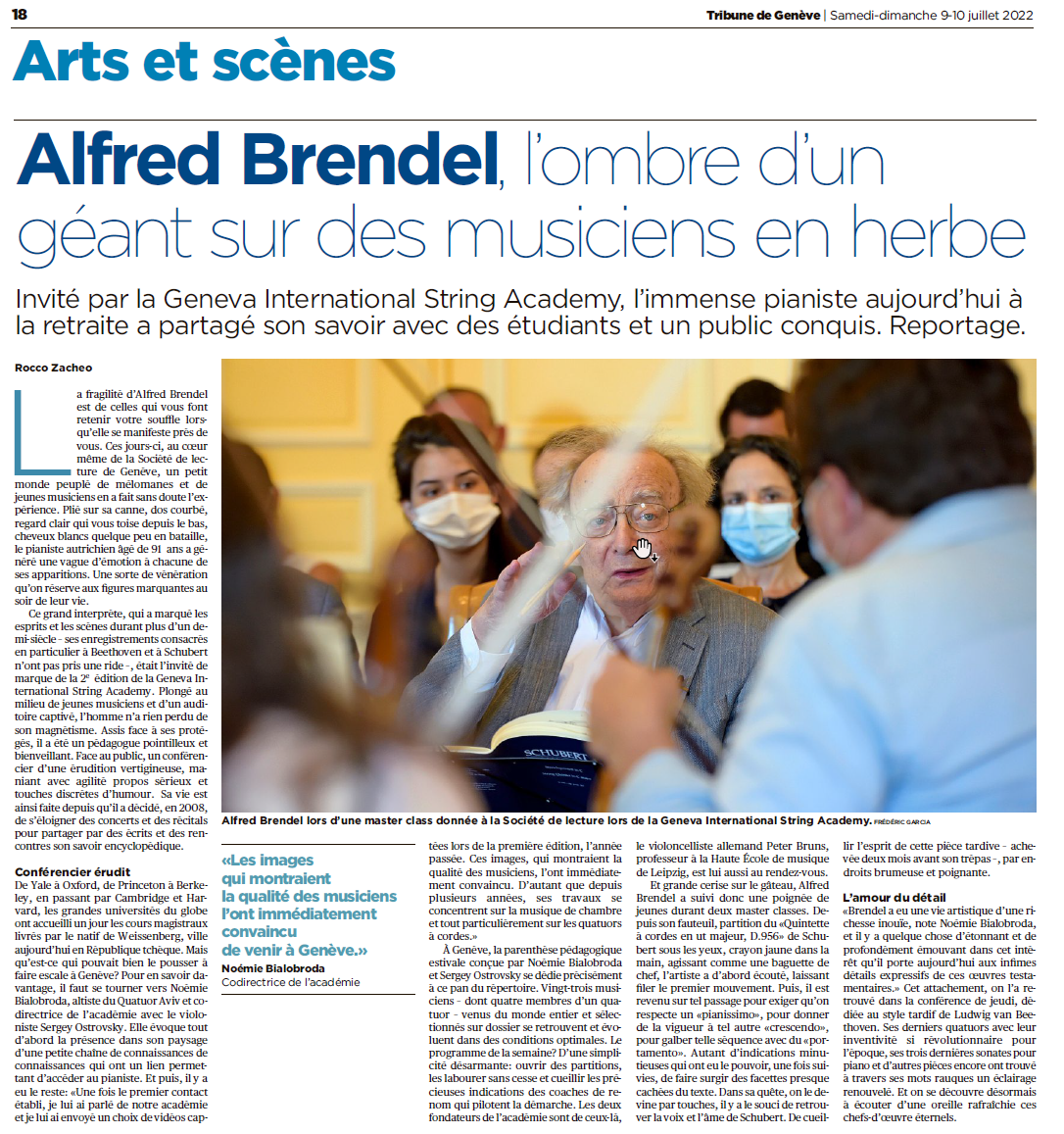
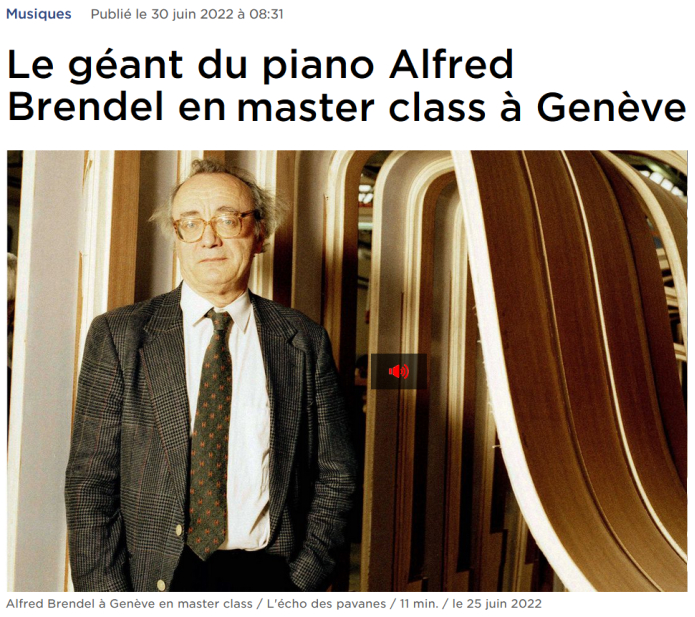
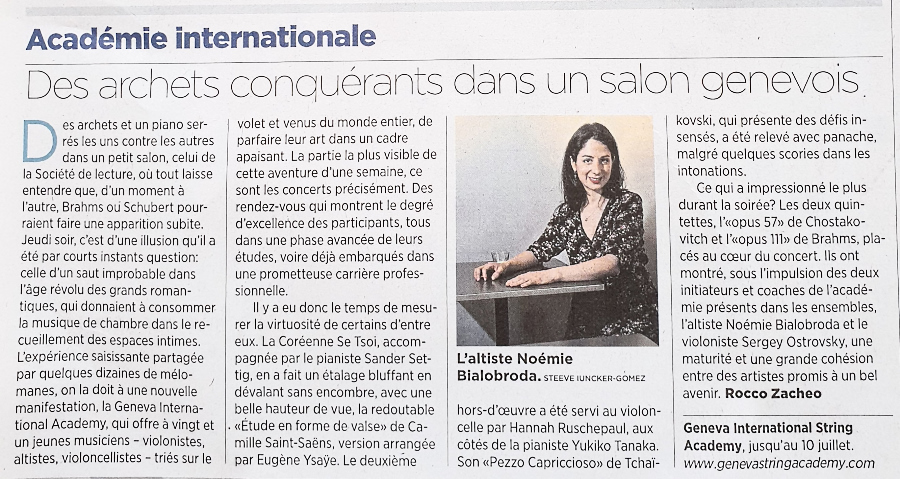
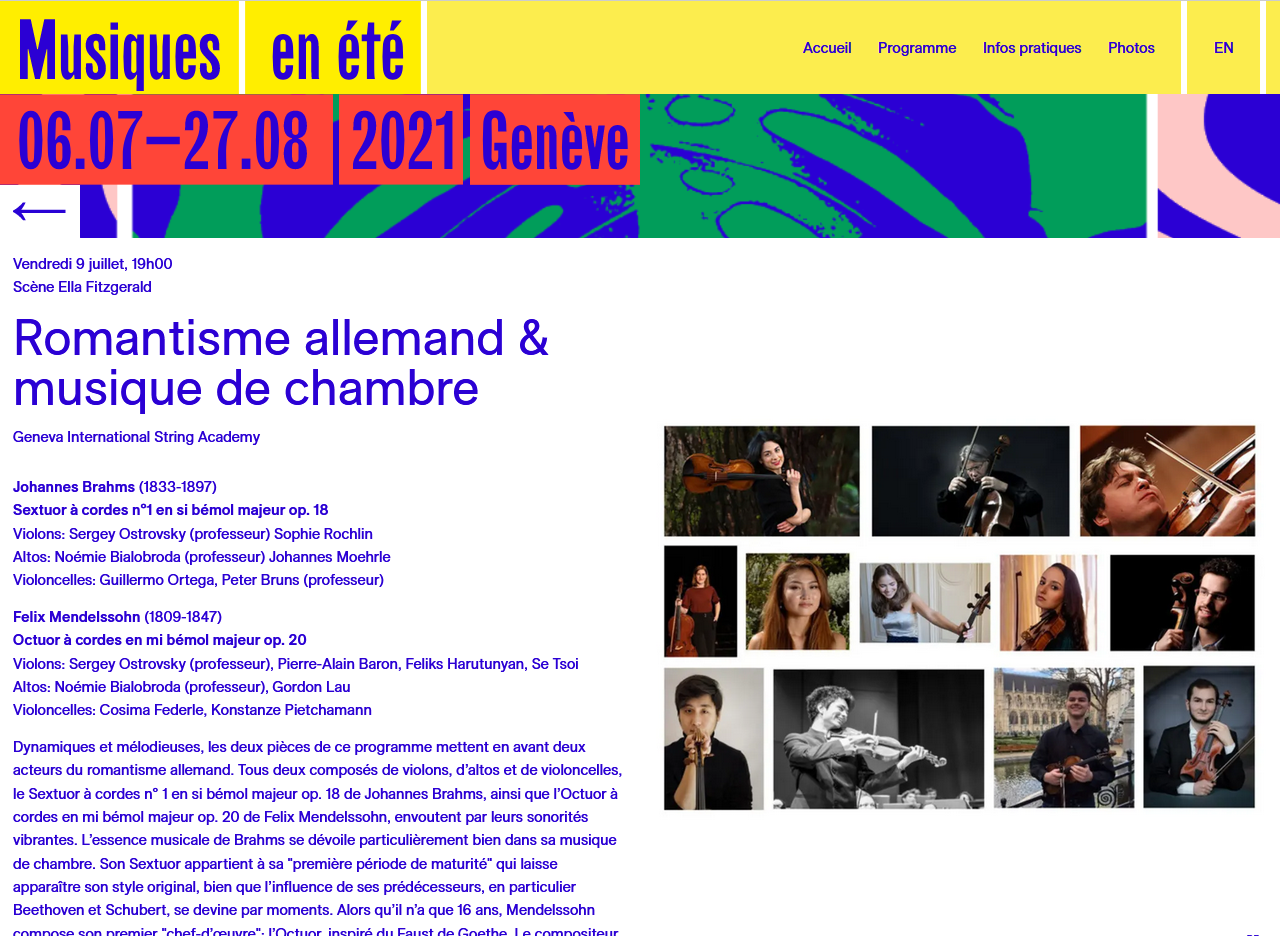
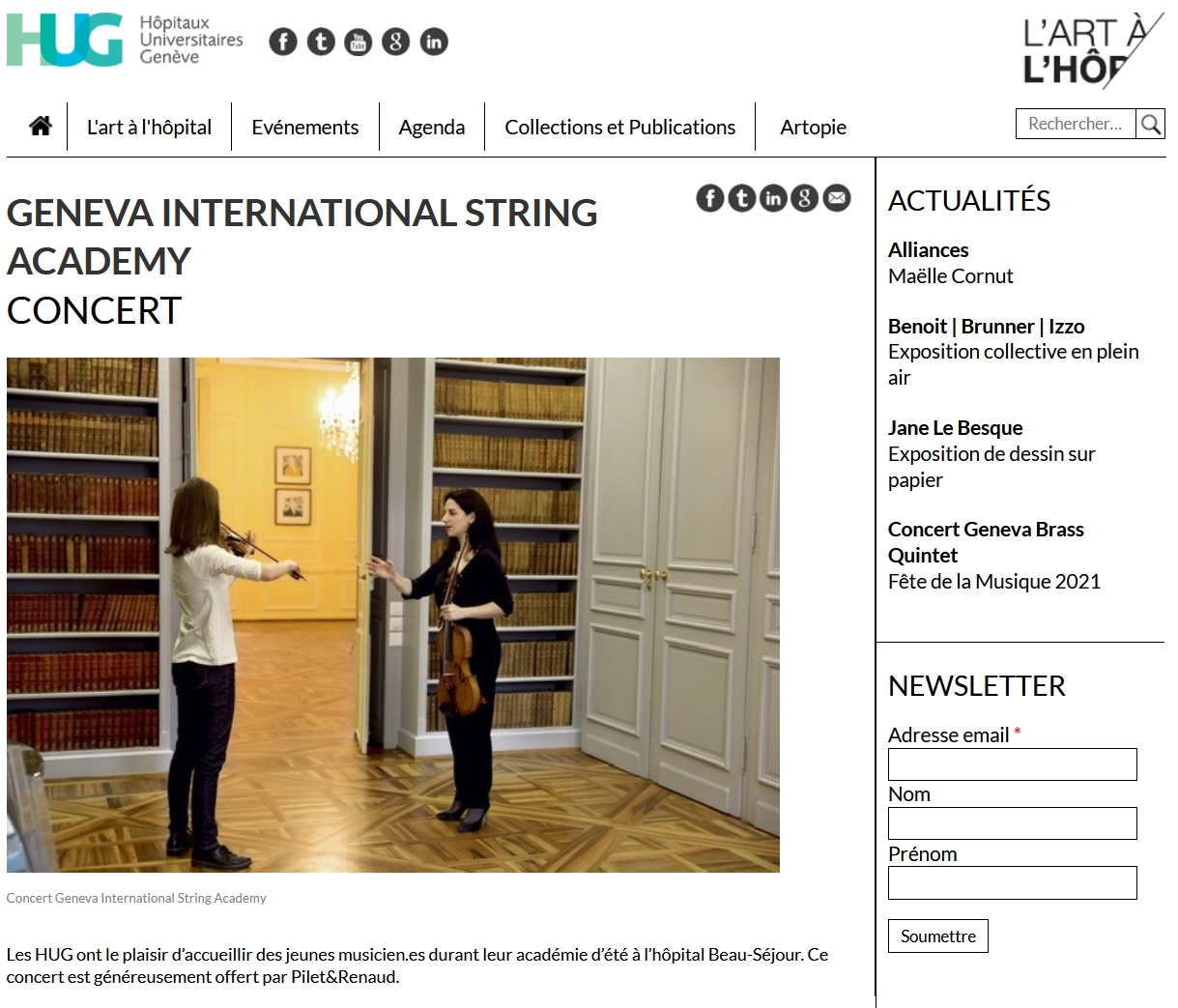
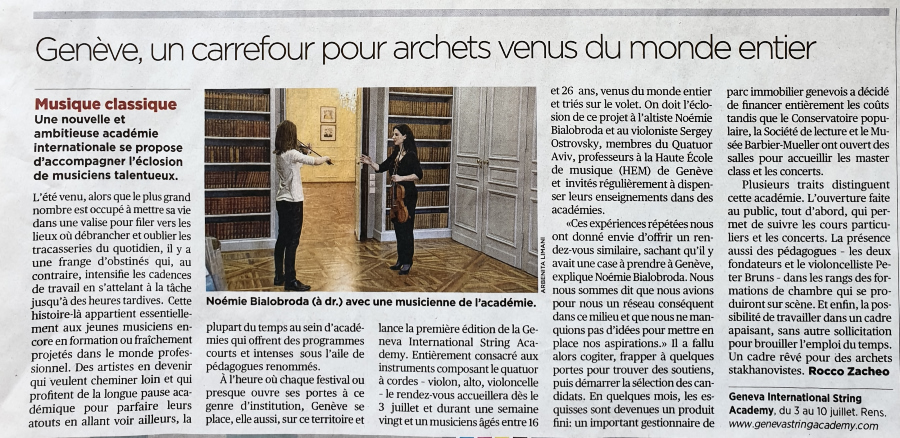
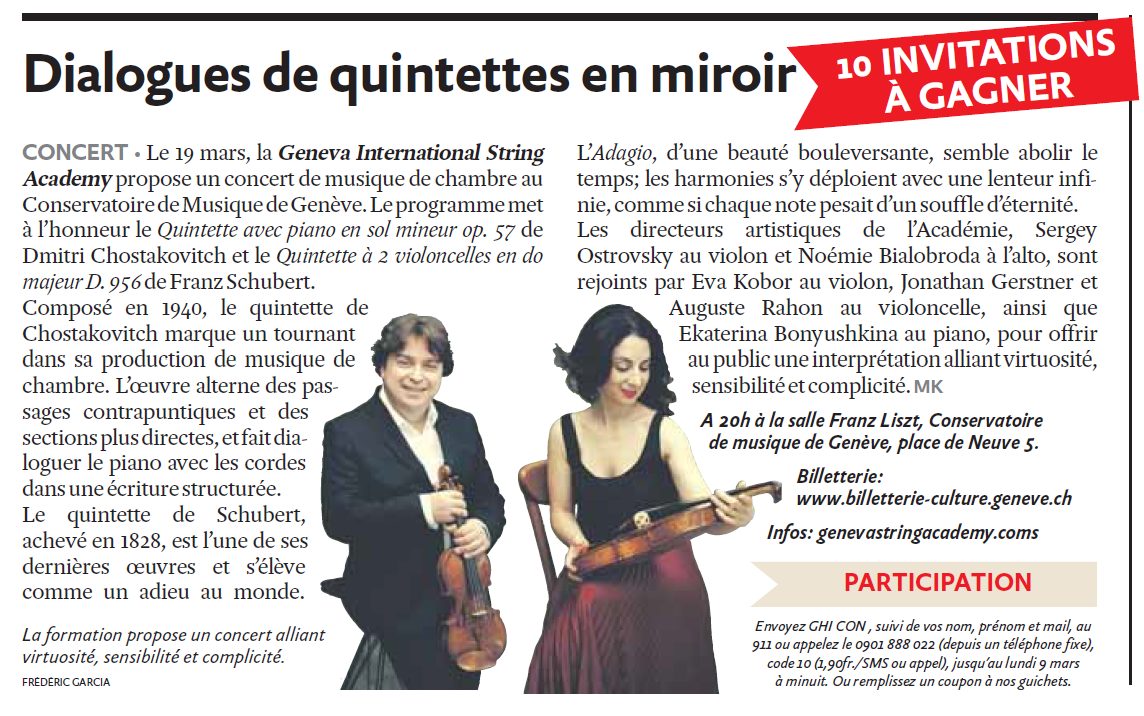
The Academy enjoys growing media visibility, in French-speaking Switzerland and in the international music press.
Press coverage





 CloseCloseCloseClose
Own media
- Documentary — 8 minutesThe spirit of the Academy in eight minutes.
- YouTube channelThe full recording of every concert, made by a professional videographer.
- FacebookNews during and between editions.
- InstagramNews during and between editions.
- genevastringacademy.comThe Academy’s website, with online ticketing.
Press contact
Interviews, accreditation, high-resolution visuals, access to masterclasses and concerts: we answer press enquiries.
Videos and pictures in this page created by Frédéric Garcia for the Geneva International String Academy.
The 2022 young talents with professors, and all people who helped to the success of the 2nd edition!

Teaser : the 2nd Edition in one glance of 3mn
Day 1 - July 2 2022
Day 2 - July 3 2022
Day 3 - July 4 2022
Day 4 - July 5 2022 - includes Hopital HUG & Concert extracts at Société de Lecture
Day 5 - July 6 2022 - includes Concert extracts at Musée Barbier-Mueller
Day 6 - July 7 2022 - Includes visit to EMS Les Marronniers & Concert extracts at Société de Lecture
Day 7 - July 8 2022 - Includes Concert at Société de Lecture


Please click to see full picture.
July 2 to 9 2022
Our Ambassadors
Follow the links to reach out to our GISA Ambassadors for any questions or guidance.
-

-

-

-


GISA Ambassadors Program
This is your guide to becoming an Ambassador for the Geneva International String Academy (GISA).
It outlines your role as an Ambassador, answers frequently asked questions, and includes resources to help you get started and make an impact.
Why GISA Ambassadors?
- Promote the Academy to professors and conservatories
- Attract students' applications
What is the motivation of being an Ambassador?
- Being a GISA Ambassador is an opportunity to develop leadership, communication skills, and a sense of initiative. You become part of a team, gain experience that can enrich your CV.
- Each student Ambassador will be assisted in gaining access to ClasseekLink professional network, in collaboration with our partner Classeek.
- An Ambassador is eligible to receive one set of strings.
Who can be an Ambassador:
Alumni and Professors.
GISA Calendar
- GISA Web Site ready:when Guest of honour is identified
- Flyers and Posters:December
- Applications start:October
- Applications end:March, on first Monday at 23:59.
- Summer Academy:10 days starting first week of July
What is the role of a GISA Ambassador?
Below is a list of suggested actions that a GISA Ambassador may take. These are flexible and meant to inspire, not prescribe. Be sure to read the Q&A section that follows to better understand the freedom you have in shaping your involvement according to your context and strengths.
Communication and Awareness
Introducing the Academy to Professors and Students
Contact violin, viola, and cello teachers
- Identify the most influential teachers and send them an email explaining the benefits of GISA for their students.
- Request a short meeting to present the Academy at the beginning or end of a class.
- Provide promotional materials (brochures, website links, testimonials from former students).
- Encourage teachers to personally recommend the Academy to their students.
Present GISA during chamber music classes
- Ask to give a 10-minute presentation during chamber music sessions.
- Show a slideshow with videos and testimonials from former participants.
- Leave flyers for interested students.
Distribute flyers and posters in the conservatory and practice rooms
- Place posters in strategic locations: entrance hall, cafeteria, classrooms, library.
- Leave flyers at the conservatory's front desk.
Spreading the Word on Social Media
Share posts, videos, and stories on Instagram, Facebook, and WhatsApp
- Publish a content following a calendar (e.g., one post per month, one story per week during application period).
- Use relevant hashtags (#GISA #GenevaStringAcademy).
- Encourage students to share posts to increase visibility.
Publish testimonials from past participants and masterclass excerpts
- Publish existing testimonial videos as contained in videos summarizing a day during the Academy.
- Share GISA résumé clips and explain their educational value.
- Post a “Did you know?” series about the professors and program.
Post original content: musician interviews, behind-the-scenes footage
- Conduct interactive Instagram polls (e.g., "Do you know these pieces performed at GISA? Do you know participation costs are paid by GISA? …").
Organizing Presentations and Mini-Events
Information session
- Book a room at the conservatory and invite students to a 20-minute presentation prepared by GISA.
- Show a short GISA video about the Academy and answer questions.
- Plan a Q&A session with past participants.
Live demonstration
- Invite a former participant and have him/her share their experience.
- Record and share this event on social media.
Introductory masterclass
- Ask a violin, viola, or cello professor from GISA to host a masterclass.
- Invite students to attend for free.
Engagement and Participation
Creating a Group Dynamic
Encourage students to apply together
- Set up a WhatsApp group for interested students.
- Share resources to help prepare for application forms.
- Host informal meetings to discuss GISA and address concerns.
Organizing a “GISA Day” at the Conservatory
Create an exhibition or information board
- Set up a board with photos and testimonials from past participants provided by GISA.
- Add a GISA QR code linking to the Academy’s website for easy summer application.
Offering a Digital Immersion
Screen the documentary, concert excerpts, and masterclasses
- Coordinate with the conservatory administration to display GISA content on common-area screens.
- Host a screening event followed by a discussion.
Host an Instagram Live or Zoom session
- Invite a professor from the Academy or past participant to answer questions live.
- Promote the event on social media beforehand.
Supporting Students and Follow-Up
Helping with Applications
Organize a preparation workshop
- Book a room where students can record their audition videos.
- Provide guidance on interpretation and recording quality.
- Review applications together before submission.
Connect students with former participants
- Use the GISA contact list of past GISA students.
- Arrange one-on-one conversations to address questions.
Follow up on applications and encourage undecided students
- Regularly check in with interested students to track their progress.
- Motivate hesitant students by highlighting the benefits of GISA.
Building a Network of GISA Ambassadors
Recruit students and professors from other conservatories
- Reach out to students from different music schools and invite them to be ambassadors.
- Exchange best practices and ideas.
Share experiences in a private group
- Create a Facebook or WhatsApp group to centralize information.
- Encourage the sharing of experiences and advice.
Partnerships and Visibility
Collaborating with Conservatory Administration
Include GISA in official announcements
- Request to feature the Academy in newsletters and public displays.
- Propose an article or a highlight section on the conservatory’s website.
Working with Student and Music Media
Contact student radio/ TV stations and music blogs
- Propose an interview about the opportunities GISA offers.
- Write an article about the Academy and get it published.
GISA Ambassador Q&A
Alumni
What’s the benefit for me as a GISA Ambassador?
You will be assisted in gaining access to Classeek’s professional network, in collaboration with our partner Classeek, and besides being offered one set of strings, being a GISA Ambassador is an opportunity to develop leadership, communication skills, and a sense of initiative. You become part of the team, gain experience that can enrich your CV, and in the case of strong involvement, may be invited to perform during the Winter Season at the Franz Liszt hall of the Conservatoire de Genève.
Does being an Ambassador require any formal commitment?
No. You are not obliged to commit a set number of hours or actions. The role is flexible and based on goodwill. If you support the values and standards of GISA and believe it could benefit students, your endorsement alone already makes a difference.
Will I receive training or support as an Ambassador?
Yes! We’ll provide a starter kit (with text, visuals, and examples), and you’ll be in touch with a coordinator who can help you adapt your actions to your conservatory. You’ll also be part of a network of Ambassadors where you can share ideas and experiences — and support each other.
What support will I receive from the GISA team?
You’ll have access to clear guidelines, digital materials (flyers, images, suggested posts), and a contact person to help you adapt your actions to your context. You’ll also be part of a network of Ambassadors to exchange ideas and stay informed.
How much time do I need to dedicate to this role?
It’s entirely up to you. Being a GISA Ambassador is a flexible, voluntary commitment — it can range from sharing a few posts and flyers to organizing a short info session or helping a fellow student with their application. Even a few hours spread over several months can make a meaningful impact. You define your own involvement.
Are Ambassadors expected to recruit a certain number of candidates?
Not at all. This is not a sales job, and there are no quotas.
Being an Ambassador means sharing your experience and raising awareness, not pressuring your peers. If your actions inspire one student to apply — or even just to learn more — that’s already a success.
Can I be an Ambassador even if I’m not sure I’ll apply again this year?
Absolutely. If you had a positive experience and want to help others discover the Academy, your involvement is valuable — regardless of whether you plan to apply again this year or not. Ambassadors are not limited to current applicants.
Isn’t promoting the Academy reducing my own chances of getting selected again, since I’ll attract more candidates?
That’s a valid concern, but here’s the reality:
The Geneva International String Academy seeks excellence, not a quota. Promoting GISA doesn’t reduce your chances — it elevates the overall level, creates a sense of community, and shows leadership.
Also, admissions are based on merit, not on how many apply. Being an Ambassador shows maturity, initiative, and commitment — qualities that work in your favor, not against you.
Wouldn't this role make more sense for someone who’s already attended the Academy for three years?
That’s certainly one option, and experienced alumni are of course very welcome as Ambassadors. However, motivation and energy matter just as much. Even if you’ve only attended once or twice, your voice is still powerful.
The program is designed to be flexible: some Ambassadors will be active for one season, others for longer. Everyone brings value, whether they’re new alumni or long-standing members of the GISA family.
What if I don’t feel confident speaking in public or giving presentations?
That’s completely fine. There are many ways to be an Ambassador — some prefer organizing things behind the scenes, sharing content online, or simply talking one-on-one with fellow students. Public speaking is optional. We encourage each Ambassador to contribute in a way that suits their strengths.
Do I need formal approval from my professor or conservatory to be an Ambassador?
No formal approval is required. However, we recommend being transparent if you think it’s appropriate — especially if you’d like to present during a class or post materials inside your institution. If you're ever unsure, you can always check with your conservatory or ask us for advice.
What if my conservatory doesn’t allow external promotional materials, like posters or flyers?
We’re aware that some conservatories have tightened their rules regarding promotional displays. That’s completely fine.
Ambassadors are encouraged to work within the rules of their institution — digital outreach, word of mouth, or organizing a simple Q&A session with interested students are all great alternatives. Nothing needs to be forced. Flexibility is part of the approach.
Could this role create a conflict of interest if my professor promotes another academy?
This is a very important question — and we appreciate the awareness.
We encourage all Ambassadors to be respectful of their professor’s affiliations. There is no expectation to push GISA in situations where it would create tension. Instead, you can focus on sharing your own personal experience with fellow students, outside of formal classes, or in informal peer conversations.
We trust Ambassadors to navigate these relationships with tact, and we remain available to support you if a sensitive situation arises.
With many Ambassadors, how do we stay connected and share ideas?
Even though Ambassadors are based in different countries and conservatories, we form one close-knit community.
You’ll be invited to join a private communication group (such as WhatsApp or an email circle) where you can exchange ideas, ask questions, share updates, and stay in touch.
We highlight inspiring actions taken by fellow Ambassadors, so that good ideas can travel from one conservatory to another. You’re never alone — this is a space for collaboration and encouragement.
GISA also checks in with the group regularly through a coordinator, and we may host short online meetups from time to time to share experiences or gather feedback.
You’re free to participate as much as you like — and even small contributions help the community thrive.
Whether you're launching a flyer campaign, talking to your professor, or simply posting on social media, your actions matter. Together, we build something bigger.
How do Ambassadors receive their free set of strings?
Ambassadors are eligible to receive a set of strings. The strings are provided through our partner, the luthier Atelier Pierre Barthel. You’ll simply be invited to discuss your choices with the luthier, and the strings will be either shipped to you or made available for pickup, depending on your location. We’ll reach out to coordinate everything directly.
What is Classeek, and how is it connected to the GISA Ambassador Program?
Classeek is a professional platform that supports young classical musicians by providing career tools, performance opportunities, and artist visibility. As a partner of GISA, Classeek offers selected Ambassadors the chance to join its network. GISA Ambassadors may receive personalized guidance to access Classeek's resources and connect with a broader professional community.
Do I need to provide a proof of my actions in promoting GISA?
No formal proof is required. We trust our Ambassadors and value every contribution, big or small. That said, if you share a social media post, organize a meeting, or distribute flyers, feel free to let us know — it helps us see what works.
Now that I’m an Ambassador, what should I do first?
Congratulations — and welcome! Start simple: choose one or two actions that feel natural to you.
You could share a post about GISA on social media, talk about the Academy with a fellow student or professor, or let your conservatory know about the opportunity.
The Ambassador Guide includes a list of suggested actions, but there’s no fixed path — you don’t need to do everything, just what feels right to you.
And of course, if you’d like support or ideas, we’re here to help. You're already making a difference.
Professors
What is the role of a GISA Ambassador who is a professor?
A professor Ambassador acts as a bridge between the Academy and their institution. Their role is to inform students about the opportunity, encourage talented candidates to apply, and, where possible, help raise the visibility of the Academy within their conservatory or university.
What kind of actions can I take as a professor Ambassador?
You can:
- Share the call for applications with your students.
- Recommend the Academy to particularly promising young musicians.
- Display posters or forward newsletters within your department.
- Allow short presentations during your chamber music or instrumental classes.
- Serve as a contact person within your institution if students have questions.
- All of this is voluntary, and tailored to your availability and comfort level.
As a professor, can I recommend specific students for the Academy?
Yes — and your recommendation carries weight. If you know a student who would benefit from the GISA environment, we encourage you to let them know and, if appropriate, support their application with a letter or a note to the GISA team.
As a professor, what if my conservatory has rules about external promotions?
That’s entirely understandable. We encourage professor Ambassadors to adapt their involvement to their institution’s policies. In some cases, this may mean discreet word-of-mouth communication, digital forwarding of information, or private discussions with students — rather than public postings.
As a professor, is there any conflict if I’m involved in another academy or program myself?
Not at all. GISA welcomes collaboration with educators from diverse backgrounds. The Ambassador role doesn’t imply exclusivity. We understand that many professors run or support other summer programs — the aim here is simply to inform students and help them find the experience that suits them best.
How does GISA differ from other summer academies? Why support it?
GISA offers a high-level, tuition-free program in Geneva, with world-class faculty, a strong focus on chamber music, and an immersive international experience. It supports young musicians artistically and financially, aiming for excellence. Supporting GISA means supporting access to opportunity for deserving young string players.
What are the benefits for professors who support GISA?
While this is not a remunerated position, GISA acknowledges the support of its professor Ambassadors on its website and official communications. Additionally, Ambassador professors strengthen their pedagogical network.
Starter kit
Click to download the starter kit
The starter kit contains files you can download, including a powerpoint file. You will need to fill the form for getting the authorization.
I want to become GISA AmbassadorVideos
Documentary
2025 - Highlights
2024 - Highlights
Winter season - 2023/2024
Flyers - Posters


References
- Presentation done in Estonia for the ECMTA, European Chamber Music Teachers’ Association, May 2025Powerpoint presentation available in the starter kit.

I want to become GISA Ambassador
GENEVA INTERNATIONAL STRING ACADEMY
SUPPORT
Become a member
Donate
Host a student
Volunteer
Navigation
Join the Geneva International String Academy Association
The Geneva International String Academy is an association that plays a vital role in the success of the Academy. By joining the Geneva International String Academy Association, you help fund the Academy's various projects.
The annual membership fee is CHF 100 per person (CHF 180 for couples).
Membership benefits include:
- Updates on our activities via our newsletter,
- Discounted tickets for all concerts,
- A free T-shirt and bag featuring the Geneva International String Academy logo.
Furthermore, the Geneva International String Academy deeply appreciates any donations you may make to support its projects. All donations are tax-deductible, and the Association will issue a tax receipt for donors who are Swiss tax residents.
The Geneva International String Academy recognizes two main categories of donors:
Benefactors
A donation of at least CHF 500 entitles you to the following benefits:
- Updates on our activities via our newsletter,
- A free T-shirt and bag featuring the Geneva International String Academy logo,
- Two invitations to three concerts of your choice during the Academy,
- Discounted tickets for all concerts and access to the best seats for additional reservations,
- Participation in a workshop on the art of violin making with the Academy's luthier,
- Two complimentary invitations to alumni concerts throughout the year in French-speaking Switzerland.
Grand Benefactors
A donation of at least CHF 2,000 entitles you to the following benefits:
- Updates on our activities via our newsletter,
- A free T-shirt and bag featuring the Geneva International String Academy logo,
- Two invitations to all concerts during the Academy,
- Discounted tickets for all concerts and access to the best seats for additional reservations,
- Your name or organization listed in all Academy concert programs (if desired),
- A guided visit to the Société de Lecture,
- Participation in a workshop on the art of violin making with the Academy's luthier,
- Two complimentary invitations to alumni concerts throughout the year in French-speaking Switzerland,
- An invitation for two to the Academy's opening Saturday dinner with professors and accompanists.
Annual Membership
Pricing Table
Benefactor
Pricing Table
Grand Benefactor
Pricing Table
Vendredi 14 mars 2025
Salle Franz Liszt
Conservatoire de Genève
PROGRAMME DU CONCERT
Achat de billets: Billetterie Service Culturel Migros Genève ou Billetterie Service Culturel Ville de Genève
Johannes BRAHMS (1833 – 1897)
Sextuor n°2 en sol majeur op.36
I. Allegro non troppo
II. Scherzo - Allegro non troppo - Presto giocoso
III. Poco adagio
IV. Poco allegro
Sergey Ostrovsky – violon 1, Alexander Goldberg – violon 2, Sarah Strohm – alto 1, Noémie Bialobroda – alto 2, Pauline Boudon - violoncelle 1, Arne Zeller – violoncelle 2
Durée : environ 40 minutes
Johannes BRAHMS, attiré davantage par les aspects lyriques des œuvres que leurs côtés dramatiques, a toujours voué un intérêt particulier à la musique de chambre. Toutefois, ses scrupules devant l’imperfection le conduisaient à ne pas se perdre dans les domaines pour lesquels il ne se sentait pas prêt. S’agissant de la composition d’œuvres pour des ensembles à cordes, il abandonna longtemps des projets de quatuors à cordes, car insatisfait des résultats obtenus. Dès 1860, il opta pour le sextuor à cordes, genre qu’il était le premier grand compositeur à adopter et auquel il donna ses lettres de noblesse en laissant deux chefs-d’œuvre d’un aboutissement admirable. Bien entendu, la composition de quatuors à cordes suivra dans le temps, avec un succès jamais démenti. La composition du second sextuor à cordes op. 36 en sol majeur, de 1865, intervint après la rupture avec Agathe von SIEBOLD, pour laquelle il s’était enflammé quelques années auparavant, qu’il avait demandée en mariage et à laquelle il avait finalement renoncé, ne se sentant prêt à perdre sa liberté. Par cette œuvre, il avait confié à ses amis qu’il désirait « se libérer de son dernier amour ». Ainsi, BRAHMS construit un thème du premier mouvement en citant le prénom de la jeune fille qu’il met en évidence dans la notation allemande A-G-A-(D)-H-E, (la-sol-la-(ré)-si-mi).
Le premier mouvement, Allegro non troppo, s’ouvre dans un climat de douce sérénité et s’anime bientôt pour conduire à des périodes de grand lyrisme. Il est suivi d’un Scherzo de forme tripartite, qui présente un caractère essentiellement mélodique dans ses parties extrêmes, alors que le trio central fait résonner une danse rustique. Le troisième mouvement Poco Adagio, est constitué d’un thème et de cinq variations d’une grande beauté expressive. Brahms y déploie son incomparable talent d’invention et exprime une grande liberté. Enfin, le mouvement final, Poco Allegro, est essentiellement de structure rythmique et conclut cette œuvre magnifique avec brio.
ENTRACTE (20 min)
Piotr Ilitch TCHAÏKOVSKI (1840 – 1893)
Souvenir de Florence op.70 pour sextuor à cordes
I. Allegro con spirito
II. Adagio cantabile e con moto
III. Allegro moderato
IV. Allegro vivace
Sergey Ostrovsky – violon 1, Alexander Goldberg – violon 2, Noémie Bialobroda – alto 1, Sarah Strohm – alto 2, Arne Zeller – violoncelle 1, Pauline Boudon – violoncelle 2
Durée : environ 35 minutes
Au début de l’année 1890, Piotr Ilitch TCHAÏKOVSKI séjourne à Florence où il compose son avant-dernier opéra, La Dame de Pique. En été de la même année, de retour en Russie, il entreprend la composition de son sextuor à cordes qu’il dédie à Florence en souvenir des circonstances propices qu’il avait trouvées lors de son séjour. Il écrira à sa bienfaitrice, Madame von MECK, qu’il avait composé ce sextuor avec beaucoup de plaisir et d’enthousiasme et sans effort. L’œuvre, dans sa version définitive, fut jouée la première fois en 1892 par les musiciens de la Société de musique de chambre de Saint-Pétersbourg qui avait élu le compositeur à la dignité de membre d’honneur. La question du caractère italien de cette œuvre reste controversée parmi les musicologues, les uns estimant que les thèmes de cette nature sont à trouver dans les deux premiers mouvements, alors que d’autres les distinguent dans l’entier du sextuor.
L’œuvre s’ouvre par un Allegro con spirito qui débute par un sujet fortissimo qui installe un climat très énergique, le mouvement étant enrichi progressivement de divers motifs nouveaux. Le second mouvement, Adagio cantabile, débute par un choral qui débouche sur une cantilène confiée au premier violon, puis au violoncelle, accompagnée de pizzicati soutenus. La partie centrale revêt un caractère fantasmagorique, elle est traversée de rapides traits qui conduisent au retour de la cantilène. L’Allegretto moderato qui suit comporte un premier thème d’allure manifestement plus russe qu’italienne, alors que le trio qui lui succède est vif et enlevé. Le dernier mouvement, Allegretto vivace, présente des sujets de nature folklorique qui entourent un thème d’un grand lyrisme, le compositeur n’hésitant pas à utiliser le sujet russe pour écrire un fugato dont il n’était pas peu fier.
ARTISTES

Sergey OSTROVSKY
Fondateur du Quatuor à cordes Aviv et professeur de violon à la Haute École de Musique de Genève, Sergey Ostrovsky a également été premier violon solo de l’Orchestre de la Suisse Romande de 2007 à 2012 et Premier Violon solo de l'Orchestre de la Communidad Valenciana, de 2012 à 2014.
Par ailleurs, Sergey est régulièrement invité comme chef d'orchestre au Suisse, en Espagne, en Ukraine et en Israël.
Il est fondateur et directeur Artistique de l'Orchestre « Les Solistes de Neuchâtel ».
Né en 1975 à Nijni-Novgorod (Russie) dans une famille de musiciens, Sergey commence à jouer du violon à l'âge de 6 ans avec D. et L. Lapidus Gantman.
En 1991 Sergey Ostrovsky a immigré en Israël où il se perfectionne à l'Académie Rubin de Tel Aviv avec Yair Kless et Irena Svetlova. Il est également diplômé du Conservatoire Royal de Rotterdam (N. Morozova) et du Conservatoire d'Amsterdam (Alexander Kerr).
Sergey Ostrovsky a gagné le Grand Prix du Concours International de Musique de Chambre de Melbourne et il est lauréat du Concours International de Quatuor à cordes de Bordeaux. Il a également remporté le Prix "Schubert" et le 2ème prix au Concours International « Schubert et Modernité » (Graz, Autriche). Il est en outre lauréat du Concours International « Printemps de Prague ».
En tant que soliste, Sergey joue avec des orchestres prestigieux tels que l’Orchestre de la Suisse Romande, l’Orchestre Philharmonique d’Israël (avec Zubin Mehta et Yoel Levi), l’Orchestre Philharmonique de Cape Town, l’Orchestre Chambre « Amadeus » (Pologne), le Bournemouth Symphony Orchestra, le Jerusalem Symphony Orchestra ou l’Orchestre de Chambre d'Israël.
En tant que chambriste, Sergey a joué dans les plus prestigieuses salles du monde, tels que le Carnegie Hall, l’Alice Tully Hall, l’Auditorium du Louvre, le Théâtre du Châtelet, le Wigmore Hall de Londres, le Sydney Opera House, etc.
Sergey joue un violon de Giovanni Grancino (1716) qu’il a pu acquérir grâce au généreux soutien de M. J. Mayer et de "Tzfonot Tarbout" – organisation à but non lucratif pour les arts et les artistes en Israël.
Il est co-fondateur et responsable artistique de la Geneva International String Academy.

Noémie BIALOBRODA
Noémie Bialobroda est l’altiste du Quatuor Aviv depuis 2014 avec lequel elle mène une intense carrière internationale. Leur intégrale des quatuors de Beethoven au Studio Ansermet à Genève en 2018-2019 a rencontré un vif succès auprès du public genevois et a confirmé leur implantation en suisse romande.
Passionnée par l'enseignement, Noémie Bialobroda est Professeur de Musique de Chambre à la Haute École de Musique de Genève, Coordinatrice de Musique de Chambre à la Haute École de Musique de Genève. En 2024, elle est nommée Professeure d'alto au Conservatoire National Supérieur de Musique de Lyon. L’été, elle enseigne à l’Académie Internationale de Musique de Solsona en Espagne et elle est professeur de Musique de Chambre à l’Académie Internationale de Musique de Flaine. Ses élèves sont lauréats de concours nationaux et internationaux.
Noémie Bialobroda a reçu une Bourse culturelle de la Fondation Leenaards 2024.
Comme concertiste, elle est l’invitée de saisons prestigieuses et festivals telles que Wigmore Hall (Londres), le Festival Manifeste de l'IRCAM, la Cité de la Musique (Paris), pour n’en citer que quelques-uns. Elle collabore avec des artistes tels que Abdel Rahman El Bacha, Yovan Markovitch, Luis Claret, Boris Garlitsky, Francois Guye, Philippe Müller, Tedi Papavrami, Jean Sulem, Jean-Pierre Wallez, le Quatuor Rosamonde pour des concerts dans toute l’Europe, en Israël et aux Etats-Unis.
Engagée dans l'interprétation de la musique contemporaine, elle est la dédicataire de deux pièces pour alto solo crées à l’IRCAM : le Caprice pour alto seul et électronique du compositeur japonais Keita Matsumiya (2012) et Drifting de Pierre Stordeur (création avril 2013). Elle est régulièrement invitée à jouer avec l’Ensemble Modern de Francfort et l’ensemble contrechamps à Genève.
Noémie Bialobroda a étudié avec Nobuko Imai et Miguel Da Silva à la Haute école de Musique de Genève puis au Conservatoire National Supérieur de Musique de Paris en Diplôme d'Artiste Interprète (3ème cycle) où elle se perfectionne auprès de Jean Sulem.
Elle est fondatrice et responsable artistique de la Geneva International String Academy.
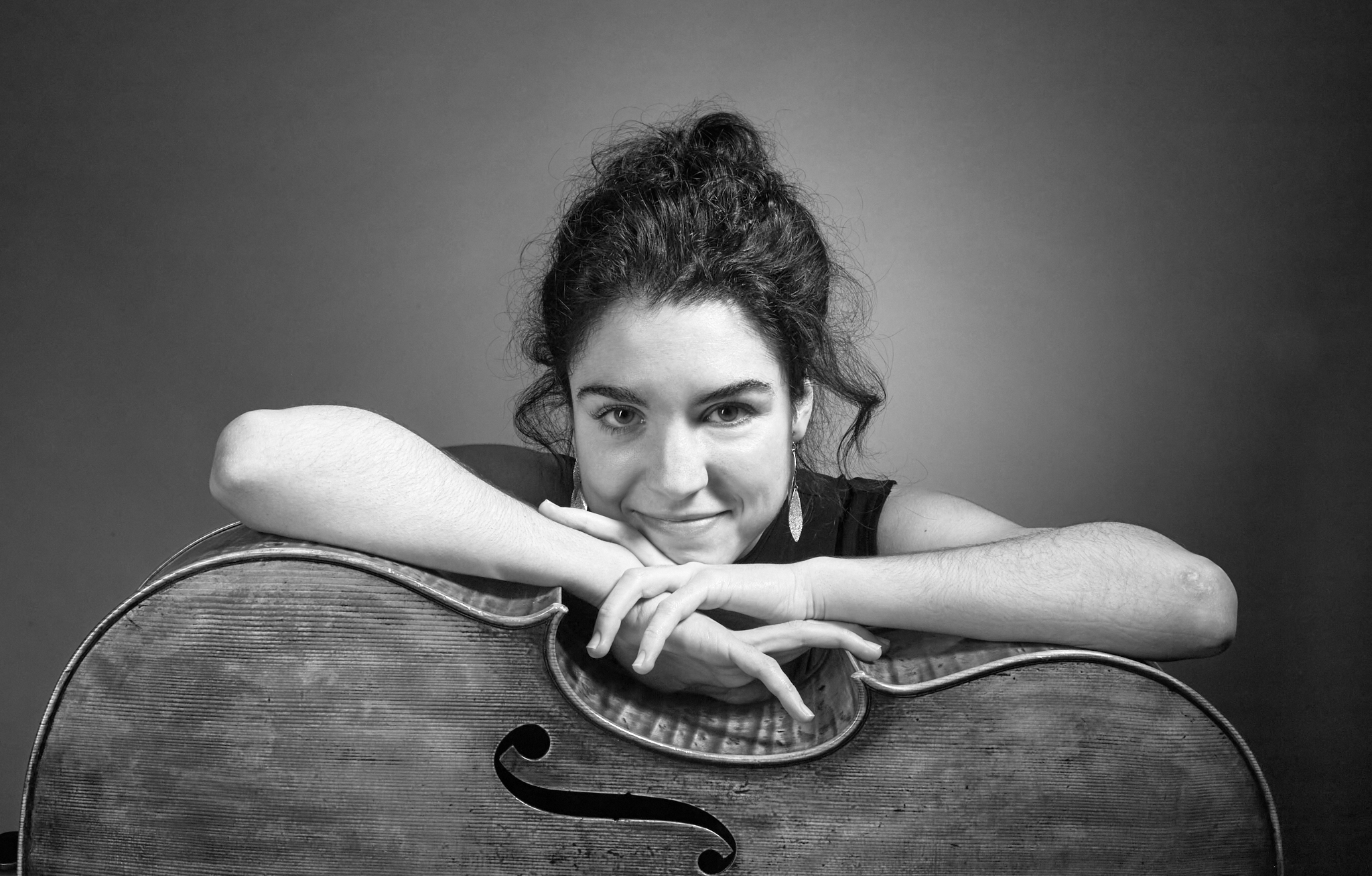
Pauline BOUDON
Pauline Boudon commence le violoncelle à l’âge de trois ans à Lyon. Pour ses études, elle rejoint le Conservatoire de St Maur-des-Fossés avant d’entrer à l’unanimité au CNSMD de Paris à l’âge de 17 ans, dans la classe de Jérôme Pernoo et Cyrill Lacrouts, dont elle sort diplômée d’une licence mention Très Bien à l’unanimité avec félicitations du jury. Elle complète ensuite sa formation en Master auprès de Marc Coppey, Tatjana Uhde et Pauline Bartissol.
En 2022, elle est sélectionnée aux masterclasses de l’Académie Kronberg, puis se produit à la Biennale de violoncelle d’Amsterdam. En 2023, elle intègre la promotion Brahms de l’Académie Philippe Jaroussky où elle travaille avec Anne Gastinel. Passionnée par la musique de chambre, Pauline intègre en 2024 le CNSMDP en master avec Iris Scialom et Nicolas Bourdoncle (trio) dans la classe de François Salque, Claire Désert et Louis Rodde. Elle se produit très régulièrement en duo violoncelle-piano avec Martin Jaspard.
Elle est membre fondateur du Quatuor Citadelles, au sein duquel elle bénéficie de l'enseignement de François Salque et de Jean Sulem, ainsi que celui de Miguel Da Silva.
Elle joue régulièrement avec l’Orchestre de l’Opéra de Paris, et est invitée dans de nombreux festivals, notamment aux Rencontres Musicales de la Baule, au Festival de La Chaise Dieu, aux Musicales du Plessis Bourré, au festival Musica, à la Geneva String Academy, au festival du Pontlevoy, au festival Musée en Musique.
Elle partage la scène avec d’éminents musiciens, parmi lesquels Ulf Wallin, Peter Bruns, Anne Gastinel, François Salque, le Quatuor Arod, Marianna Shirinyan, Marc Coppey. Elle reçoit en outre l’enseignement de Valentin Erben, Antoine Lederlin, Corina Belcea, Frans Helmerson, Luis Claret, Gary Hoffman.
En juin 2024, à la Seine Musicale, elle interprète les Variations Rococo accompagnée par l’Orchestre de la Garde Républicaine.
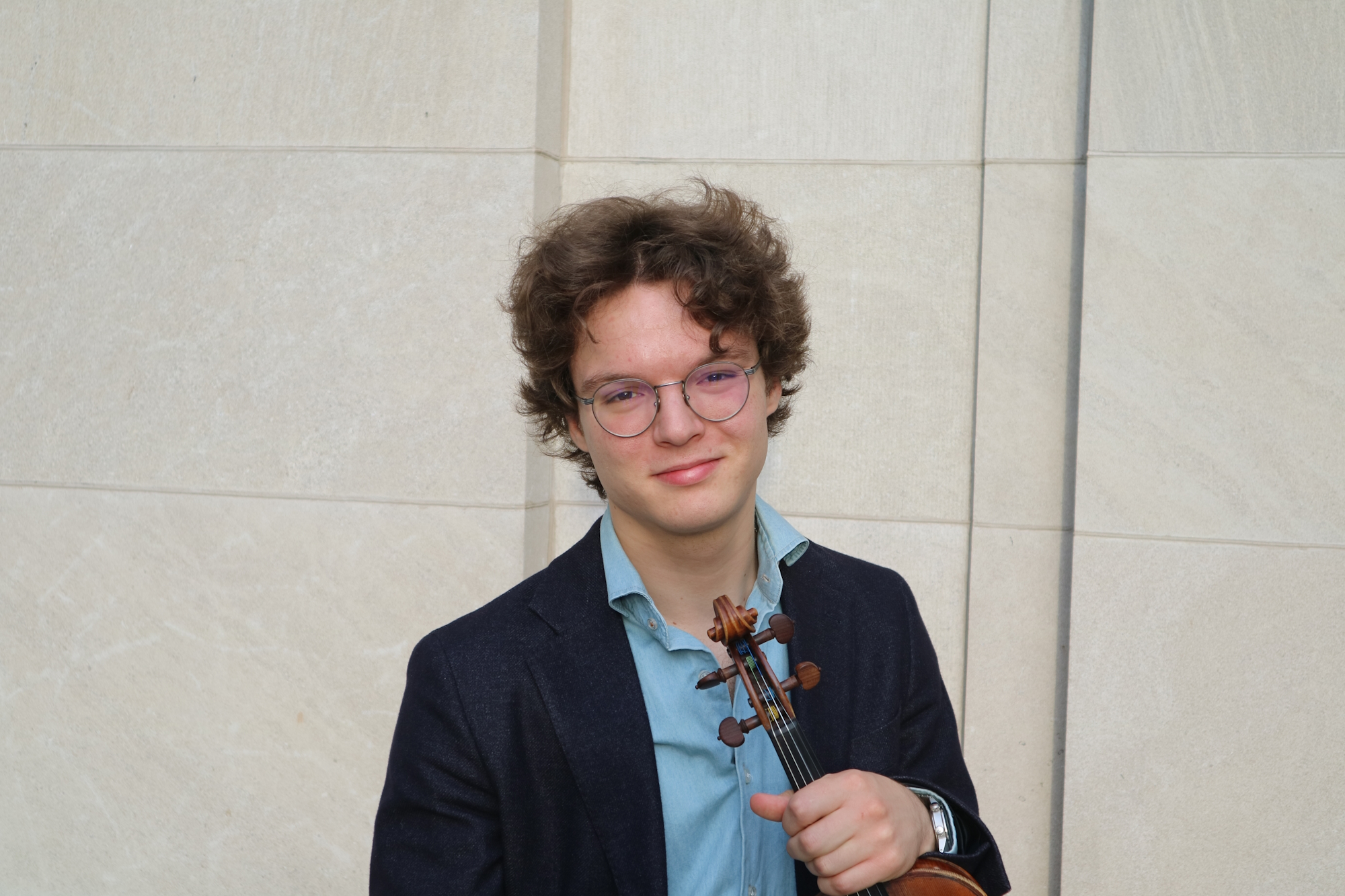
Alexander GOLDBERG
Le violoniste américano-italien Alexander Franco Goldberg, âgé de 23 ans, est un interprète ardent et sensible qui relie la musique à des considérations esthétiques et littéraires plus larges, enrichissant ainsi ses performances. Alexander est passionné par le lien entre les performances musicales et la littérature, la poésie et l'art. Il a étudié avec Salvatore Accardo à Crémone au Centre Stauffer pour les cordes.
Il a récemment obtenu un master en violon à la Yale School of Music, où il a été le premier et le seul étudiant admis dans le nouveau programme de double diplôme BA/MM de Yale ; il est diplômé de Yale avec un BA en philosophie cum laude. À Yale, Alexander a reçu la "Head of College Cup" pour un accomplissement intellectuel exceptionnel et une promesse créative, et le prix Selden pour sa verve, son idéalisme et son intérêt constructif pour la musique et les humanités. Alexander continue à lier musique et recherches académiques en tant que chercheur adjoint au Centro di Sonologia Computazionale de l'Université de Padoue, où il travaillera sur des installations musicales multidisciplinaires et multimédias.
Il a remporté le premier prix au concours de concerto William Waite de Yale, interprétant le concerto pour violon de Brahms avec le Yale Symphony; et a récemment remporté les premiers prix aux concours de violon Maria Labia, Vittorio Vitti et Città D'Alessandria, ainsi que le deuxième prix au concours inaugural Grunewald à Berlin.
La musique de chambre constitue une partie essentielle de l'identité musicale d'Alexander : il a étudié à la Taos School of Music et a reçu une bourse de mérite complète pour Music@Menlo. Il est retourné à Taos lors d'une tournée de concerts de sensibilisation au Nouveau-Mexique, où il a interprété des quatuors aux côtés de Nina Lee du Brentano Quartet.
Alexander est également passionné par la musique contemporaine et les genres innovants. Il a été membre de l'Académie contemporaine du Festival de Lucerne et a joué en petit ensemble avec Gilles Apap sur la scène du Casals Forum de l'Académie de Kronberg. En tant que lauréat du concours international de musique contemporaine du Festival de Reate, il a présenté un programme de Bach et Berio dans leur série de concerts d'automne 2023, en plus de donner une conférence lors de leur événement de sensibilisation scolaire Progetto Scuole.
Parmi les faits marquants de la saison récente, citons des performances en tant que soliste dans la Fantasia Concertante de Tippett avec le Yale Philharmonia et une performance en quatuor au Santa Fe Pro Musica. Il s'est produit à la Weill Recital Hall de Carnegie Hall en tant que lauréat du concours "American Protégé International Competition", et au Jordan Hall de Boston pour l'émission "National Public Radio’s From the Top". Il a étudié avec Ani Kavafian (2018-2023), Donald Weilerstein (2014-2018) et Ilya Gringolts, avec qui il a suivi des Corsi di Perfezionamento à l'Accademia Chigiana.

Sarah STROHM
Après avoir étudié sous la tutelle de Noémie Bialobroda à Genève, Sarah Strohm a rejoint en septembre 2024 la classe de Jean Sulem au Conservatoire National Supérieur de Musique et de Danse de Paris.
Sa participation depuis son jeune âge à des concours internationaux lui a valu de se faire remarquer à plusieurs reprises. A seulement 16 ans, elle obtient le 2ème prix du concours Johannes Brahms (2021). Lauréate d’une mention honorifique et du prix pour la meilleure interprétation de la pièce d’Oskar Nedbal au concours international d’alto Oskar Nedbal (2023), elle est en 2025 la plus jeune demi-finaliste du prestigieux concours d’alto Lionel Tertis. Elle a aussi reçu le 1er prix du concours de la Aims Fondation pour jouer en soliste avec orchestre symphonique (2019).) Au niveau national, elle a remporté le 1er prix du concours Valiant Forum dans le cadre du festival Murten Classics (2023) et est également multi-lauréate du Concours suisse de musique pour la jeunesse (2016 ; 2018 ; 2022 ; 2024).
En parallèle, Sarah participe régulièrement à des académies internationales de haut niveau comme l’Académie des solistes du Verbier Festival, la Seiji Ozawa International Academy, les master-classes de l’IMS Prussia Cove, les Lac Leman Music Masterclasses, Keshet Eilon String Mastercourse, la Geneva International String Academy ou encore les Workshops de l’Académie Kronberg. Elle a ainsi pu se perfectionner auprès de personnalités artistiques de renom comme Nobuko Imai, Tatjana Masurenko, Lawrence Power, Thomas Riebl, Antoine Tamestit et Tabea Zimmermann.
Ses apparitions comme soliste incluent le concerto pour alto de Telemann avec les Boho Strings (festival Murten Classics), le concerto pour alto de Hoffmeister avec le Collegium Musicum Basel, le double concerto pour alto et clarinette de Bruch, la Romance de Bruch ou encore le Pot-pourri pour alto et orchestre de Hummel. Enfin, son implication dans le domaine de la musique de chambre lui a permis de se produire aux côtés de musiciens confirmés comme Corina Belcea, Peter Bruns, Svetlana Makarova, Sergey Ostrovsky, Antje Weithaas et Robin Wilson.
Sarah est soutenue par la fondation Lyra et la fondation Ruth et Ernst Burkhalter.
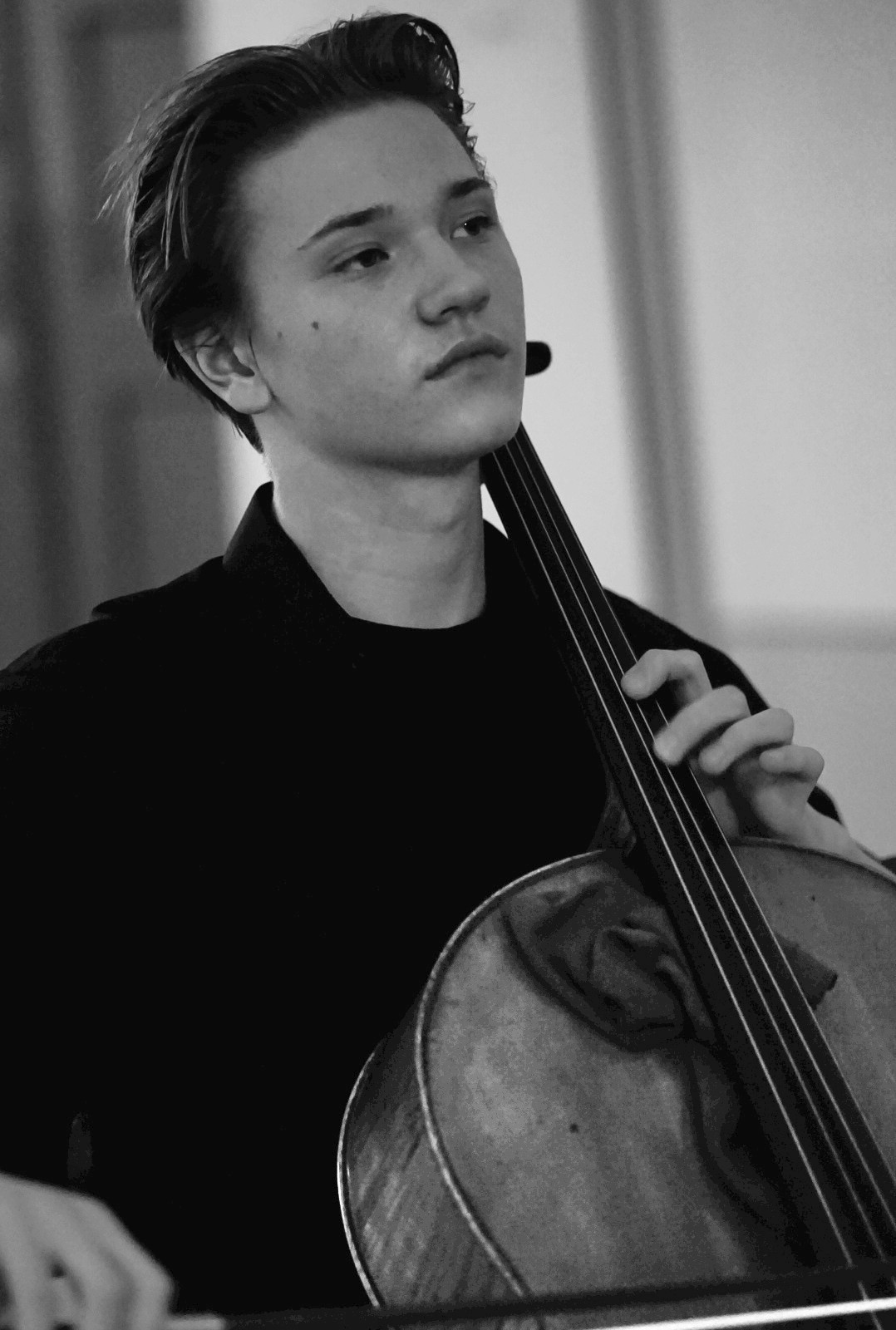
Arne ZELLER
Arne Zeller a commencé à jouer du violoncelle à l'âge de six ans et est devenu membre de la classe pré-universitaire du professeur Peter Bruns à la Hochschule für Musik und Theater Felix Mendelssohn Bartholdy Leipzig tout en poursuivant ses études secondaires. Après avoir obtenu son diplôme en 2024, il étudie avec Frans Helmerson à la Kronberg Academy. Il reçoit également d’importants enseignements artistiques lors de masterclasses régulières avec Jens Peter Maintz.
Il a remporté de nombreux prix et distinctions, notamment le premier prix du concours international de violoncelle Anna Kull à Graz en 2020, le premier prix du concours international Gustav Mahler de violoncelle en 2022 à Prague, le deuxième prix du 29e Concours international Brahms 2023 à Pörtschach et le premier prix du 40e Prix Pablo Casals 2024 à El Vendrell. En outre, Arne a été récompensé par de nombreux premiers prix nationaux et prix spéciaux dans le cadre du concours fédéral allemand "Jugend musiziert".
En 2022 et 2024, Arne a participé activement aux masterclasses de violoncelle de la Kronberg Academy, où il a également été sélectionné comme junior pour "Chamber Music Connects the World" en 2024. Il a acquis une précieuse expérience en musique de chambre lors de cours internationaux tels que la Geneva International String Academy, la Henle Chamber Music Academy et le programme des solistes de la Verbier Festival Academy. Il a également été académiste au Festival de Moritzburg et au Festival Con Spirito de Leipzig.
Dans le cadre de ses activités de concert, il a eu le privilège de partager la scène avec des artistes tels que Gidon Kremer, Lawrence Power, Jens-Peter Maintz, Peter Bruns, Valentin Erben, Noémie Bialobroda, Sergey Ostrovsky, Jan Vogler et Torleif Thedéen, ainsi qu’avec l’Eliot Quartett.
Arne a fait ses débuts en tant que soliste avec orchestre à l'âge de 13 ans, interprétant les Variations Rococo de Tchaïkovski. Il s’est ensuite produit avec les Philharmoniques de Baden-Baden, l’Euro Symphony Orchestra, le MainKammerOrchester et la Kremerata Baltica. En 2024, il a également joué en tant que soliste avec le Frankfurt Radio Symphony Orchestra à plusieurs reprises dans le cadre d'un projet destiné aux écoles, y compris celles à besoins éducatifs particuliers. La même année, il s'est produit en soliste avec l'Orchestre universitaire de Mayence devant 2 000 élèves du primaire à l’"Alte Oper" de Francfort, sous la direction de Felix Koch.
De 2021 à 2024, Arne a été membre de l’ensemble de renommée internationale "LGT Young Soloists", acquérant une expérience scénique précieuse tant en musique d’ensemble qu’en tant que soliste lors de concerts à travers le monde. Il a également bénéficié d'impulsions artistiques supplémentaires à travers des masterclasses avec Ivan Monighetti, Hans Jørgen Jensen, Jan Vogler, Gary Hoffman et Steven Isserlis.
Depuis octobre 2024, Arne forme, avec le violoniste Leonhard Baumgartner et le pianiste Simon Haje, un trio avec piano qui entreprendra une tournée de concerts internationale en 2025, soutenue par la Music Academy Liechtenstein.
Arne Zeller est boursier de la "Deutsche Stiftung Musikleben", de l'International Music Academy Liechtenstein et de la Studienstiftung des Deutschen Volkes. Il bénéficie également du soutien de la Peter-Klöckner-Stiftung et de l'association "Freunde junger Musiker Mainz/Wiesbaden".
Parmi ses autres distinctions notables figurent le Lichtenberger Musikpreis 2022, le Werner Stiefel Preis 2022, le Martin Stadtfeld Prize, la bourse Jütting 2023 ainsi que la bourse Pergamenschikow lors des masterclasses de violoncelle de la Kronberg Academy en 2024.
Arne joue gracieusement sur un violoncelle Charles Adolphe Maucotel "ex-Tortelier" (Paris, 1850), prêté généreusement par un membre de la Stretton Society. Lauréat du prix du "Deutscher Musikinstrumentenfonds", il joue également un violoncelle d’Antonio Sgarbi, Rome 1894, prêté par le "Kulturkreis der deutschen Wirtschaft" au sein du BDI e.V.